2026-02-25
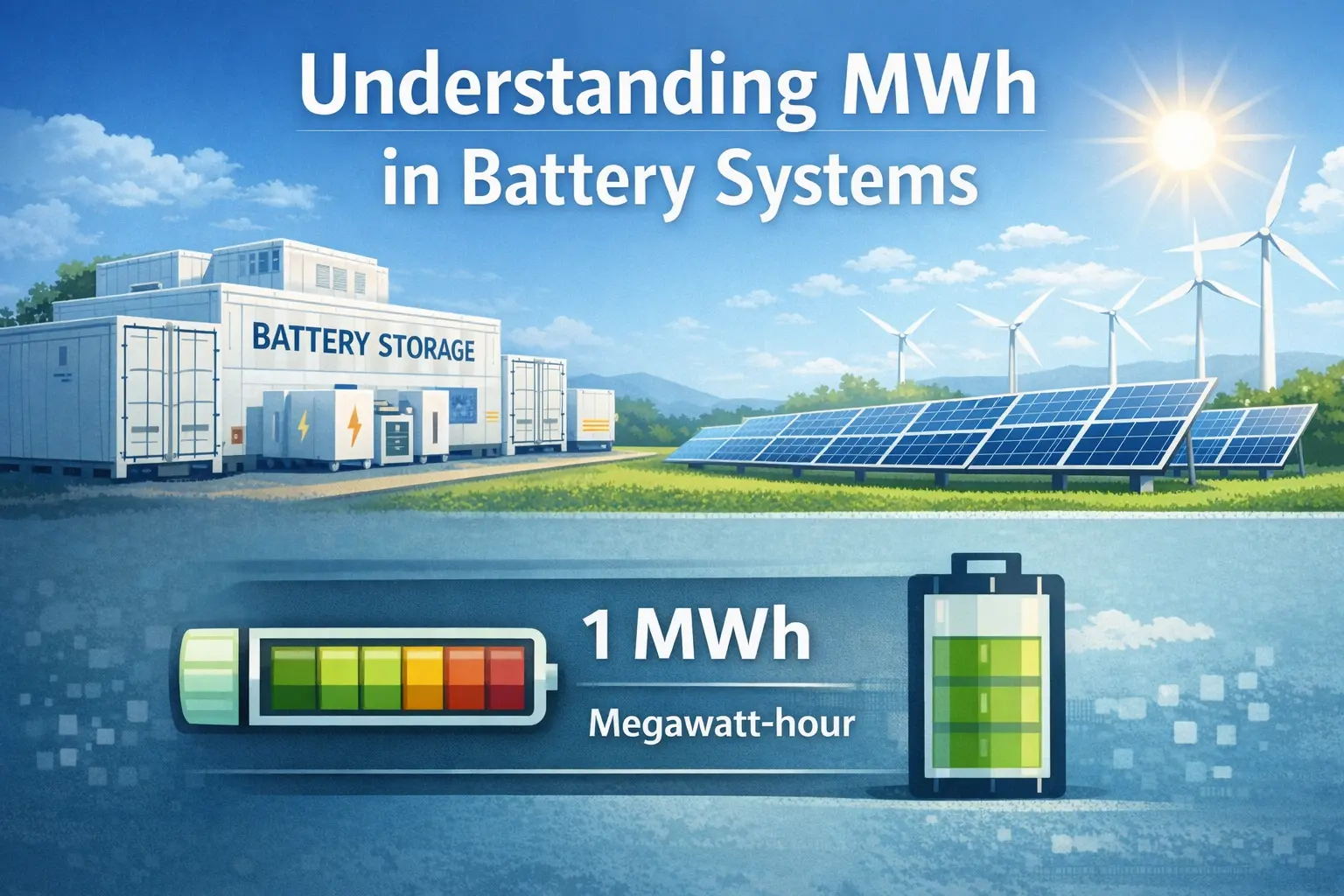
MWh (Megawatt Hour) in the battery system means the quantity of energy delivered in the form of one Megawatt of power for the duration of one hour. In other words, it tells you the total amount of electricity your battery has the capacity to store. If your battery has the capacity to store 1 MWh of energy, it means it has the capacity to deliver 1 MW of power for one hour, 0.5 MW of power for two hours, and 2 MW of power for half an hour. That’s the simple answer. But to understand it correctly, you must understand the battery system correctly.
One of the most common confusions in the battery system revolves around the difference between MW and MWh.
Think of MW as "speed" and MWh as "distance." The MW rating of a battery tells you how fast it can discharge. The MWh rating of a battery tells you how long it can discharge at that rate.
For example:
A 10 MW / 20 MWh battery system can:
This concept is the foundation of battery energy storage system design.
MWh is generally more important than kWh in utility-scale and commercial battery projects. While kWh is used for home battery applications, MWh is used for large-scale battery projects.
To put it into perspective:
| Application Type | Typical Capacity |
|---|---|
| Residential home battery | 5–20 kWh |
| Commercial & industrial | 500 kWh – 5 MWh |
| Utility-scale grid storage | 10–500+ MWh |
A 100 MWh battery project is not unusual in today’s world. In fact, it is common in many countries with large renewable energy portfolios.
For example, the Tesla Megapack battery projects have been reported to have capacities of over 100 MWh.
The formula for calculating the energy capacity of batteries is:
Energy (Wh) = Voltage (V) * Capacity (Ah)
The result is then divided by 1,000,000 to get the MWh value.
Example:
A battery bank is rated at:
1000 V
1000 Ah
Using the formula above, we can calculate that the energy capacity of the battery is:
Energy = 1000 * 1000 = 1,000,000 Wh = 1 MWh
However, in real-world scenarios, the actual MWh value that can be used is slightly lower due to factors like:
For Lithium Iron Phosphate (LiFePO4) battery technology, which is used in most modern BESS installations, the usable energy capacity can be considered to be 90-95% Depth of Discharge.
Let's assume that there's a 50 MW solar farm that's paired with a 200 MWh battery system.
What does that mean?
With time-of-use pricing markets, this will allow the following:
From my experience working with commercial battery system designs, selecting the correct MWh capacity often depends more on peak demand duration than peak demand itself. Many clients initially focus only on MW power, but the real economic return depends on how long the system can sustain output.
Battery capacity in MWh plays a vital role in the following grid applications:
With regards to frequency regulation markets, systems with a capacity to operate for 1 hour are common in this type of market. However, in the case of energy shifting and capacity markets, systems with a capacity to operate for 2-4 hours are common.
It is worth noting that in most markets, a “standard duration” for a battery in the grid has been defined as 4 hours. This implies that:
A 100 MW battery project will require a capacity of at least 400 MWh.
To make MWh more tangible:
1 MWh = 1,000 kWh
1 MWh can power:
~100 average U.S. homes for about 1 hour
~1,000 homes for about 6 minutes
Here’s a simplified comparison:
| Energy Unit | Equivalent |
|---|---|
| 1 kWh | Power a 1 kW appliance for 1 hour |
| 1 MWh | 1,000 kWh |
| 1 GWh | 1,000 MWh |
Large grid-scale battery projects are now reaching GWh-level capacities, especially in renewable-heavy markets.
In the battery business, professionals usually use the term "duration" when discussing batteries.
Duration = MWh ÷ MW
Typical values:
The longer the duration, the higher the cost of the project but the greater the flexibility.
One interesting fact is that with the reduction in battery costs in the last ten years, battery manufacturers are now designing battery systems with greater duration. It has been reported in the industry that the most common battery system in new grid-scale battery projects in several countries around the world has a 4-hour duration.
The capacity of the battery does not remain the same over the entire lifespan.
Over the lifespan:
Lithium-ion batteries experience capacity loss.
A 100 MWh battery will be able to deliver:
95 MWh after a few years
80-85 MWh at the end of life (depending on the battery)
In the battery business, it has been observed that in the contract, the following values are usually mentioned:
If we look at it from an investment perspective, MWh is an important factor in determining how much revenue a storage system can potentially earn.
Typically, revenue can be generated from various channels such as:
The bigger your storage capacity in terms of MWh, the more energy you can potentially shift or store and earn from it. However, it also has to be taken into consideration that it has to be supported by good market conditions.
If we pile up too much MWh without sufficient price spread, it would result in reduced returns. Thus, it has to be taken into consideration before deciding on a system size.
In battery systems, it has to be noted that MWh indicates stored energy and not instantaneous output. It indicates how long a battery system can discharge energy. Thus, it is an important factor in battery systems.
If we look at it from a broader perspective, including MW, duration, and efficiency, we would get a comprehensive idea of battery system performance. Thus, it would be important to consider it from all these factors. In addition, it would also be important to consider it from a utility perspective as it would ultimately determine how much energy we would be able to use.