2025-12-09
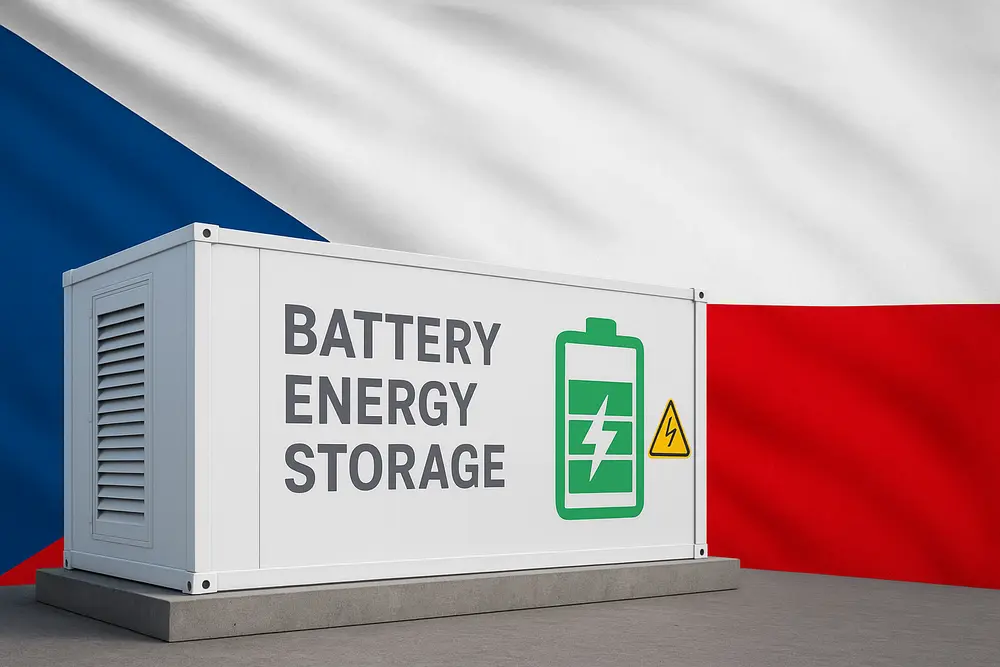
The Czech Republic has rapidly updated its regulatory framework for battery energy storage systems (BESS) in line with EU directives. Historically, storage was not separately regulated (beyond pumped hydro being treated as generation). Recent Energy Act amendments (Lex OZE/“Lex RES III”) have changed that. From late 2024 onward, standalone batteries (“electricity accumulation”) are formally recognized as a licensed activity. At the same time, small producers gained easier access: the generation‐license threshold was raised from 50 kW to 100 kW, and a storage unit co‐located with a renewable generator needs no separate license if its capacity is ≤20% of the generator’s size. New flexibility‐aggregation rules permit private consumers and aggregators to trade stored power, and clear property rights allow owners to lease or sell storage capacity to different users. In short, Czech law now treats BESS more like generation – a change experts hail as “a significant step forward” toward grid stability.
Recent rules align Czech grid codes with EU standards. All network‐connected BESS projects must meet the PPDS Annex 4 (P4) technical requirements (advanced inverter functions: voltage/frequency regulation, fault‐ride‐through, etc.). Grid operators are streamlining interconnection: storage projects ≤10 MW now use a simplified “filing” process (reduced approval time from 6 to 2 months), and utilities must publish planned connection points for storage by end‐2025. Environmental permitting remains under the general Industrial Permitting regime, with no separate environmental rules for BESS reported.
Key changes (2024–25) include:
As an EU member, the Czech Republic follows the single market rules for BESS equipment: there are no Czech‐specific import tariffs on energy storage components beyond the EU Common External Tariff. However, new EU product and trade laws impact BESS makers: under the EU Batteries Regulation (2023/1542) (in force Feb 2024), all batteries (including stationary BESS) must carry CE‐mark certification for safety and sustainability. By 18 August 2024, CE‐marking was required for all battery imports, and by 2025 producers become fully responsible for end‐of‐life collection (Extended Producer Responsibility).
At the same time, global trade tensions influence Czech investors. The EU is aggressively using trade‐defence measures against Chinese battery products (e.g. anti-subsidy probes on EV batteries). In December 2025 the European Commission announced plans to speed up anti-dumping/countervailing investigations and encourage supplier diversification by 2026. For example, EU leaders have signaled that by 2026 firms may be required to reduce over-reliance on single suppliers. Czech authorities have also sounded security alarms: the national cybersecurity office warned of potential risks in Chinese‐made solar inverters, and a similar scrutiny could extend to foreign BESS electronics. In practice, Czech importers must therefore ensure compliance with both EU battery‐safety rules and any future EU trade measures (e.g. anti‐dumping duties).
The Czech state and EU funds now actively support battery storage deployment. Key programs (2023–25) include:
The table below summarizes major support schemes:
| Program/Call | Focus | Budget/Support | Key Details (2024–25) |
|---|---|---|---|
| EU Modernisation Fund (BESS) | Grid-scale energy storage | CZK 7 billion (≈€279 m) | Supports 1.5 GWh of storage (all tech). Grants up to 50% of capex; auctions by end-2025. |
| Komunerg (Energy Communities) | Community PV + storage | CZK 1 billion | For non-profit energy communities. Funds new PV & battery systems. Applications open from Dec 2025. |
| Nová Zelená Úsporám (NZÚ) | Residential PV and storage | CZK 117 billion total | Long-term home energy retrofit program. 2023 budget top-up of CZK 55 billion for PV + batteries. Grants cover insulation, PV panels and co-located batteries. |
| PV/Storage Grant Calls (MF/RRF) | Commercial & municipal PV+storage | Various (50–75% rate) | Multiple calls (2024–25) for new PV plants (50 kW–>1 MW) including batteries or electrolyzers. Subsidy rates up to 50–75% for businesses and small towns. |
| Grid Flexibility Projects (national) | System upgrades/acceleration zones | — | Not yet deployed: Czech lawmakers are discussing “acceleration zones” for renewables (including storage) with fast-tracked permitting (similar to recent laws on wind/solar). Expected proposals in 2026 aim to streamline EIA and connection for large projects. |
Apart from direct subsidies, tax incentives and R&D grants are also available (e.g. Technology Agency programs for energy innovation). In all, investors should note that combining storage with renewables often yields higher subsidy points, as industry associations expect (e.g. Modernisation Fund calls now reward projects “with accumulation”).
Czech policy is closely tied to EU rules. The late-2024 Lex OZE 3 amendment explicitly transposed key EU electricity-market directives. In practical terms, this means Czech law now enshrines EU concepts like storage participation in balancing and aggregator markets. As one legal analysis explains, the new law “implements aspects of the [EU] directive on energy” by formally recognizing standalone storage and flexibility aggregation. The Czech grid codes and subsidy programs likewise reflect EU commitments (e.g. the EU’s Net-Zero Industry Act and REPowerEU priorities). For BESS manufacturers and investors, this means local regulations follow the EU Batteries Regulation (CE-certification, recycling standards) and the EU Electricity Market Directive (unbundling, market access for storage). In short, Czech rules largely mirror EU policy, and further EU initiatives (e.g. industrial batteries incentives, green hydrogen links) will shape the market.
Looking forward, BESS policy in Czechia is expected to become even more supportive. Analysts project a tenfold growth in storage capacity by 2030 (from ~0.3 GWh to 3.5 GWh) if targets are met. Planned reforms include battery recycling regulations (EPR) in 2026 and cross‐border storage markets with neighbors. New auction rounds are likely: Modernisation Fund calls may appear annually until 2027. EU rule updates (e.g. mandatory supply-chain due diligence by 2027) will also affect BESS imports.
Investors should watch several trends. First, grid‐connection reforms continue – for example, draft legislation in late 2025 proposes streamlining connection milestones and enabling capacity tenders (paralleling moves in neighboring countries). Second, EU trade strategy favors domestic supply chains: by 2026 the EU may require critical‐tech projects to diversify suppliers and give preference to EU-made components. Finally, the market will need to adjust to forthcoming recycling and safety costs. Taken together, these factors mean that while Czech BESS regulations are trending positively (more clarity and support), investors should plan for evolving EU compliance (trade duties, battery standards) as they deploy new storage projects.
Czech Republic policy now strongly favors BESS deployment, complementing Europe’s clean‐energy goals. Experts agree the changes are transformative: EGÚ Brno’s Michal Macenauer says formalizing standalone storage and flexibility “is a significant step forward” for stabilizing the grid and attracting investment. Industry leaders also see momentum: Jan Fousek of the Solar Association notes that subsidy programs will reward storage-enhanced projects (“higher point benefits for projects with accumulation”). For energy investors and battery manufacturers, this means a more transparent regulatory landscape and growing financial support, albeit in a dynamic EU-wide context. As one analyst observes, achieving the Czech Republic’s ambitious renewables targets will depend on continuing to unlock storage value through both legislation and markets. With mid-2026 slated for further legal reforms (including waste-recycling rules) and accelerating trade measures at the EU level, strategic BESS investments in Czechia will need to stay nimble – but the direction of policy is clearly toward expansion of storage capacity.